

You’ve polished your essays, lined up recommenders, and maybe even conquered the GMAT or GRE. But now comes the part that rattles even the strongest applicants: the MBA interview. For many, it feels like the moment of truth — where everything you’ve written has to come alive in person.
And the anxiety is real. What if they ask me something unexpected? What if I blank? What if I sound scripted? As someone who’s sat on admissions committees, I can tell you: the interview isn’t about catching you off guard — it’s about seeing who you are, how you think, and whether you’ll thrive in the program.
In this guide, I’ll walk you through the MBA interview questions you’re most likely to face in 2026, how to answer them, what questions you should ask, how to practice effectively, and what committees are really looking for.
Why MBA Interviews Matter More Than You Think
Admissions committees already know you’re qualified — your application proved that. The interview is about:
- Testing your communication skills
- Evaluating fit with the program culture
- Confirming the story you told in your essays
If you treat it like a casual chat, you’ll miss opportunities. If you over-script it, you’ll sound robotic. The sweet spot is structured, authentic storytelling.
Most Common MBA Interview Questions (with Insider Tips and Sample Answers)
Classic “Tell Me” Questions
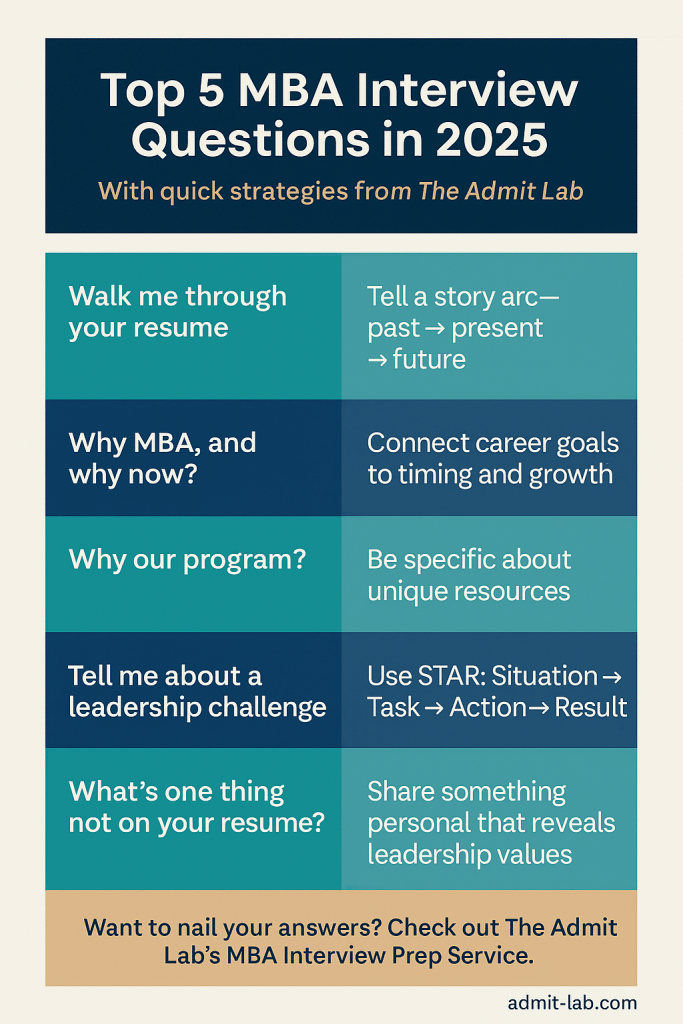
- “Walk me through your resume.”
- “Why an MBA, and why now?”
- “Why our program specifically?”
👉 Insider tip: Don’t just repeat what’s on paper. Frame it as a story arc — past experiences, present motivations, future goals — all aligned with the program’s strengths.
Career and Goal Questions
- “What are your short-term and long-term career goals?”
- “What will you do if those goals don’t work out?”
👉 Show ambition but also flexibility. Committees want to see that you have a vision but won’t collapse if Plan A doesn’t happen.
Leadership and Behavioral Questions
- “Tell me about a time you led a team.”
- “Describe a conflict and how you handled it.”
- “What’s your biggest professional achievement?”
👉 Use the STAR method (Situation, Task, Action, Result). Keep it tight and quantifiable.
How to Answer the Toughest MBA Interview Questions
1. “What’s one thing not on your resume?” (HBS favorite)
Answer approach: Share something personal but relevant to your leadership or character.
“I grew up helping my parents run a small restaurant. It taught me resilience and customer focus — qualities I still bring to team leadership today.”
2. “What would you do if you don’t get into business school?”
Answer approach: Show adaptability.
“My goal is to pivot into consulting, so I’d continue building skills in my current role, pursue certifications, and reapply with stronger leadership experiences.”
3. “Tell me about a failure.”
Answer approach: Be real, but focus on growth.
“I mismanaged a project timeline early in my career, which cost our team credibility. I learned to manage stakeholder expectations more proactively, and since then I’ve delivered every project on time.”
4. “Why our program?”
Answer approach: Be specific.
“Kellogg stands out to me because of the MMM dual-degree program — it’s the only one that blends design innovation with management. That’s directly aligned with my career goal of leading product strategy in climate tech.”
5. “Tell me about a leadership challenge.”
Answer approach: Use STAR, highlight impact.
“I once led a team with conflicting priorities across departments. By creating a shared project dashboard and clarifying deliverables, we cut confusion and completed the launch two weeks ahead of schedule.”
6. Wharton’s Team-Based Discussion
Here, it’s less about the answer and more about how you collaborate. Practice listening, building on others’ points, and staying calm under time pressure.
👉 CTA: These questions feel manageable in theory — but under pressure, most applicants stumble. If you want expert, one-on-one practice, check out my MBA interview prep service designed to sharpen your answers and calm your nerves.
Questions You Should Ask in an MBA Interview
Applicants often forget this part — but the questions you ask show judgment. Weak: “What’s the average class size?” (that’s on the website). Strong:
- “How does the program support students pivoting into climate tech roles?”
- “What recent changes in the curriculum have students found most impactful?”
How to Practice Without Sounding Scripted
One of the biggest mistakes I see is over-rehearsing. Applicants memorize answers word-for-word — and it shows. The best interviewees sound polished but natural.
Here’s how to practice the right way:
- Bullet-point, don’t script. Write down 3 key ideas for each story, not a full speech.
- Say it out loud. Your brain processes spoken words differently than written ones. Practice with a timer.
- Record yourself. You’ll catch filler words, rushed pacing, or robotic tone.
- Simulate the real thing. Do a mock interview over Zoom with a colleague or coach.
👉 If you want structured, high-pressure practice, my MBA interview prep service includes live mock interviews modeled on HBS, Wharton, and other top schools.
MBA Round 2 deadlines & interview windows (2025-26 cycle)
Note: Some interview windows below are approximate, based on past MBA admissions cycles. Official dates are confirmed where schools publish them directly.
| Business School | Round 2 Deadline | Interview Window | Decision Date | Source |
|---|---|---|---|---|
| Harvard Business School | January 5, 2026 | Late Jan – Early Mar 2026 | March 25, 2026 | HBS |
| Stanford GSB | January 7, 2026 | Mid-Jan – Mid-Mar 2026 | April 2, 2026 | Stanford |
| Wharton (UPenn) | January 6, 2026 | February 2026 | March 31, 2026 | Wharton |
| Kellogg (Northwestern) | January 7, 2026 | Rolling ~6 weeks after deadline | March 25, 2026 | Kellogg |
| Chicago Booth | January 6, 2026 | Rolling until decisions | March 26, 2026 | Booth |
| Columbia Business School | January 6, 2026 | Rolling post-submission | March 31, 2026 | Columbia |
Alt text: MBA Round 2 deadlines and interview timelines for HBS, Stanford, Wharton, Kellogg, Booth, and Columbia in the 2025-26 cycle.
What MBA Admissions Committees Really Look For
It’s not about perfect answers. Committees want:
- Clear, realistic goals
- Self-awareness about strengths and gaps
- Authentic stories that match your application
- Contribution to the community
Preparing for a Specific School?
Once you’ve practiced the most common MBA interview questions, take the next step with my insider guides for the top programs:
- 📘 Harvard MBA Interview Guide
- 📘 Wharton MBA Interview (TBD + Reflection)
- 📘 Booth MBA Interview Guide
- 📘 Columbia MBA Interview Guide
- 📘 Stanford GSB Interview Guide
Each breakdown includes the interview format, real applicant insights, and strategies to help you stand out at that school.
Facing an MBA interview soon? You’re not alone — and the pressure can feel intense. As a former admissions insider, I know the interview isn’t about catching you off guard; it’s about understanding who you are beyond your application. The questions below represent what schools really ask and what they’re hoping to hear — so you can prepare with confidence and show up as your strongest, most authentic self.
FAQs About MBA Interview Questions
What questions are usually asked in an MBA interview?
Most MBA interviews cover your professional background, career goals, why you want an MBA, and why you’re applying to that specific program. You’ll almost always be asked to “walk me through your resume,” followed by situational or behavioral questions about leadership and teamwork. Be ready with concise stories that connect your past to your MBA future.
How do I prepare for the hardest MBA interview questions?
The toughest MBA interview questions are open-ended ones like “Tell me about a failure” or “What will you contribute to the class?” The key is to show self-awareness without underselling yourself. Use the STAR method (Situation, Task, Action, Result) to keep answers structured. What schools want is reflection and growth, not perfection.
Should I ask questions during my MBA interview?
Yes — but they need to be thoughtful. Always prepare 2–3 questions to ask your MBA interviewer. Instead of asking about rankings or basic facts on the website, ask about the program’s culture, new initiatives, or how alumni in your field stay connected. This shows you’ve done your research and are seriously picturing yourself in the program.
What’s the difference between MBA and EMBA interview questions?
Full-time MBA interview questions tend to emphasize career trajectory, goals, and fit with the program. EMBA interviews, by contrast, are more focused on your current leadership role, sponsorship support, and how you’ll balance work with study. Both require clarity on “why this program” but the EMBA process leans more toward professional maturity and immediate application of skills.
How can I stand out in an MBA interview?
You stand out by showing clarity, confidence, and fit — not by giving a “perfect” answer. The most memorable applicants connect their personal story to their career goals and demonstrate they understand the specific MBA community they want to join. Practice your answers, but avoid sounding rehearsed. Real, reflective, and specific always beats generic and polished.
These FAQs cover the most common MBA interview questions and answers applicants search for — plus insider context you won’t find elsewhere.
Conclusion
MBA interviews are not meant to trip you up — but they do separate polished candidates from the ones who aren’t ready. And here’s the tricky part: you don’t know which version of you will show up under pressure.
That uncertainty is exactly why so many otherwise strong applicants stumble. They prepare their essays for months, but spend a weekend on interview prep — and it costs them an admit.
👉 If you don’t want that to be your story, check out my MBA interview prep service. Together we’ll make sure your answers aren’t just “good enough,” but compelling, authentic, and admissions-ready.
📅 MBA Timeline
Stay ahead of deadlines with my free MBA preparation timeline — a step-by-step roadmap.
Download Free✍️ Essay Editing
Get expert feedback on your MBA essays so they stand out instead of blending in.
Edit My Essays🎯 Free Consultation
Not sure where you stand? Book a free consult and get clarity on your next steps.
Book Now
Dr. Philippe Barr is a former professor and graduate admissions consultant, and the founder of The Admit Lab. He has helped applicants gain admission to top PhD, MBA, and master’s programs worldwide.
He shares weekly admissions insights on YouTube.