


The MIT PhD acceptance rate is among the lowest in the world, reflecting the extreme selectivity of doctoral admissions at the Massachusetts Institute of Technology. Each year, tens of thousands of applicants compete for a limited number of fully funded PhD positions across fields such as engineering, computer science, physics, and economics.
But like Harvard, the headline number doesn’t tell the full story. MIT’s doctoral admissions process is highly decentralized, meaning acceptance rates, cohort sizes, and competitiveness vary significantly by department and research area.
This guide breaks down the MIT PhD acceptance rate in 2026, program-level competitiveness, funding packages, and what MIT admissions committees are actually evaluating when they review PhD applications.
What Is the MIT PhD Acceptance Rate in 2026?
MIT’s PhD programs are among the most selective in the world, but the exact level of competition varies significantly by department. While many applicants search for a single MIT PhD acceptance rate, doctoral admissions at MIT are largely determined at the departmental level. The number of applicants, available faculty advisors, and funding resources within each field can strongly influence how competitive admissions are in a given year.
Some of MIT’s most competitive doctoral programs attract thousands of applicants annually. For example, the Electrical Engineering and Computer Science (EECS) PhD program reported more than 4,400 applications in the 2025 admissions cycle. The MIT Economics PhD program typically receives around 800 applications per year and admits roughly 30 students. Similarly, MIT Physics reported more than 2,000 applicants in recent admissions cycles while admitting only a small cohort of doctoral students.
Because MIT doctoral admissions are closely tied to research supervision and funding availability, acceptance rates can fluctuate from year to year. The table below illustrates how competitiveness can vary across several MIT PhD programs.
| MIT PhD Program | Recent Admissions Data | Estimated Acceptance Rate |
|---|---|---|
| MIT EECS PhD | 4,444 applications reported in the 2025 admissions cycle | Extremely competitive; exact admit rate varies by year |
| MIT Economics PhD | About 800 applications per year and roughly 30 admits | Approximately 3–4% |
| MIT Physics PhD | 2,082 applicants and 62 admits reported in 2025 | Approximately 3% |
| MIT Engineering (Mechanical, AeroAstro) | Large applicant pools each year | Estimated 6–9% |
| MIT Architecture and Media Lab programs | Smaller cohorts with selective admissions | Estimated 10–14% |
These figures illustrate how selectivity varies across MIT doctoral programs depending on applicant volume, faculty availability, and research funding in a given admissions cycle.
What MIT Looks for in PhD Applicants
GPA, Research Experience, and Letters
MIT seeks top academic performers, but the strongest applicants also understand how to align their experiences with program values. If you’re applying, make sure to study common MIT PhD application tips shared by successful admits. Competitive applicants typically have a GPA of 3.8 to 4.0, especially in quantitative and technical disciplines. Many MIT PhD programs have made the GRE optional or have eliminated it entirely; applicants should check specific departmental requirements. In recent years, many programs have made the MIT PhD GRE optional, but requirements vary by department.
Beyond academic metrics, MIT values applicants who demonstrate exceptional research experience, strong faculty endorsements, and a clear alignment with the institute’s mission. A compelling Statement of Purpose that articulates your research interests and how they align with MIT’s strengths can significantly enhance your application.
MIT PhD Requirements: What Admissions Committees Expect
Many applicants search for a definitive list of MIT PhD requirements, but doctoral admissions at MIT are not driven by strict cutoffs. Like other top research institutions, MIT evaluates applicants holistically based on research potential, intellectual fit, and the availability of faculty supervision.
That said, successful applicants tend to demonstrate several consistent strengths.
Strong Academic Performance
Most admitted students have excellent academic records, often with GPAs of 3.8 or higher in rigorous programs. However, MIT does not publish official GPA cutoffs, and exceptional research experience can outweigh weaker grades in some cases.
High-Level Research Experience
Research experience is often the most important factor in MIT PhD admissions. Committees are looking for applicants who can formulate research questions, navigate uncertainty, and contribute meaningfully to ongoing projects. Publications, thesis work, lab experience, or technical projects can all strengthen an application.
Compelling Letters of Recommendation
Strong letters of recommendation are critical. MIT admissions committees rely heavily on faculty assessments of an applicant’s research ability, independence, and long-term potential.
GRE Policy (Varies by Department)
Many MIT PhD programs have made the GRE optional or eliminated it entirely. However, some quantitatively intensive programs may still consider GRE scores as part of the evaluation process.
Clear Faculty and Research Fit
Perhaps the most important requirement is alignment with faculty research. Because MIT PhD students are closely tied to labs, research groups, and funding streams, admissions committees prioritize applicants whose research interests match existing faculty expertise.
A strong application clearly explains what you want to study — and why MIT is the right place to do it.
One reason people feel anxious about PhD applications is that they don’t realize how early strong preparation starts.
If you want a clear month-by-month plan for research prep, materials, deadlines, and decision points, start here:
Get the Free PhD Application TimelineMost applicants feel calmer the moment they see the timeline. It makes the process concrete, and it quickly shows whether a PhD realistically fits your life right now.
MIT PhD Funding and Stipend (2026)
Typical Funding Package Breakdown
MIT offers robust financial support to its PhD students. The standard MIT PhD stipend in 2026 is approximately $4,654 per month, totaling nearly $55,848 per year—plus full tuition and health insurance coverage. For the 2025–2026 academic year, the standard funding package includes:
- Tuition Coverage: Full academic year tuition.
- Stipend: Approximately $4,654 per month, totaling around $55,848 annually.
- Health Insurance: Valued at $3,603 per year.
This funding is typically guaranteed for five years for students in good academic standing. However, it’s important to note that funding can vary significantly among disciplines, and applicants should consult their specific departments for detailed information .
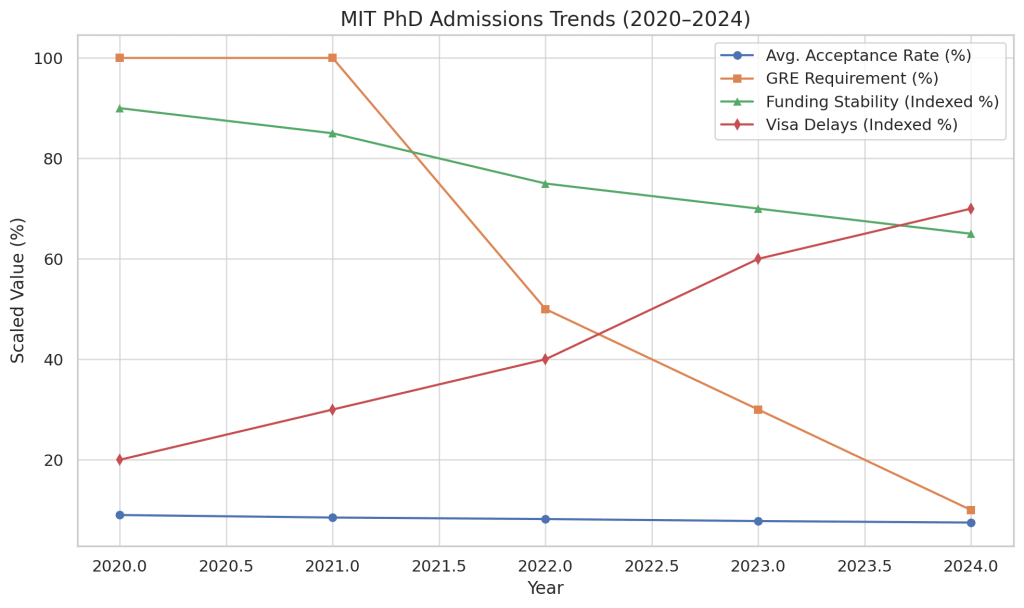
Trends in MIT PhD Admissions (2020–2026)
Several trends have emerged in MIT’s PhD admissions landscape:
- Admissions Competitiveness: MIT’s PhD programs have consistently maintained low acceptance rates, reflecting their high selectivity.
- Standardized Testing: There has been a notable shift towards making the GRE optional or eliminating it altogether in many programs.
- Funding Landscape: While certain research areas face funding challenges due to federal budget cuts, fields aligned with national priorities, such as AI and energy, continue to thrive with strong financial support.
- International Student Dynamics: Visa processing delays and stricter immigration policies have introduced uncertainties for international applicants, emphasizing the importance of early planning and awareness of alternative pathways.
One of the more encouraging trends? The MIT PhD success rate for students who make it through the admissions process and receive funding has remained consistently strong—especially for those who begin early and apply strategically.
FAQs About MIT PhD Acceptance Rate and Admissions
What is the MIT PhD acceptance rate in 2026?
The MIT PhD acceptance rate is typically estimated between 3% and 6%, depending on the department and year. Some of the most competitive programs, such as EECS, physics, and economics, may admit fewer than 1 in 20 applicants. Because admissions are handled at the departmental level, there is no single official MIT doctoral acceptance rate — and selectivity varies significantly based on funding, faculty availability, and research demand.
How hard is it to get into an MIT PhD program?
Getting into an MIT PhD program is extremely difficult, but not simply because of grades or test scores. Most applicants have strong academic records, yet admissions decisions are driven by research potential, faculty fit, and alignment with ongoing projects. In practice, many qualified applicants are rejected not because they lack ability, but because their research interests do not closely match what MIT faculty are currently prioritizing.
What GPA do you need for an MIT PhD?
Most successful MIT PhD applicants have GPAs in the 3.8–4.0 range, particularly in quantitative or technical fields. However, MIT does not have a strict GPA cutoff. Admissions committees place more weight on research experience, intellectual independence, and faculty recommendations. A slightly lower GPA can be offset by strong research output, publications, or compelling work in a lab or independent project.
Do you need GRE scores for MIT PhD programs?
Many MIT PhD programs have made the GRE optional or eliminated it entirely, though policies vary by department. In fields such as engineering, computer science, and economics, strong GRE scores can still help strengthen an application — especially if there are gaps in academic performance. That said, GRE scores alone will not make or break your chances of admission.
What does MIT look for in PhD applicants?
MIT PhD admissions committees are primarily evaluating research potential. This includes your ability to ask meaningful questions, engage with complex problems, and contribute to ongoing work in a lab or research group. Strong applications demonstrate clear research direction, relevant experience, and a close match with faculty interests. In many cases, this alignment matters more than raw metrics like GPA or test scores.
Can you get into MIT PhD without publications?
Yes, it is possible to get into an MIT PhD program without formal publications, especially if you are applying directly from undergraduate study. However, you still need to demonstrate meaningful research experience. This could include thesis work, lab experience, technical projects, or independent research. What matters most is showing that you understand the research process and can contribute at a high level.
Is MIT PhD fully funded?
Yes, most MIT PhD programs are fully funded. This typically includes full tuition coverage, a monthly stipend, and health insurance. Funding is usually guaranteed for around five years, provided the student remains in good academic standing. However, funding structures can vary slightly by department and research area.
What are my chances of getting into MIT for a PhD?
Your chances of getting into an MIT PhD program depend less on your profile in isolation and more on how well it fits the specific department and faculty you are applying to. Many applicants focus on improving grades or test scores, but admissions committees are ultimately asking a different question: does this applicant’s research belong here? The strongest candidates are those who understand that and position their application accordingly.
Final Thoughts and Application Tips
Applying to MIT’s PhD programs in 2025 requires not only academic excellence but also strategic planning, especially in light of evolving funding landscapes and immigration policies.
As a former professor, admissions committee member, and current admissions consultant, I understand the intricacies of the application process and the challenges applicants face. If you’re seeking personalized guidance to navigate this complex landscape, consider reaching out for expert advice tailored to your unique situation.
Ready to take the next step in your academic journey? Let’s work together to craft a compelling application that stands out.
Further Reading: MIT Admissions, PhD Strategy, and Related Programs
MIT’s PhD programs are exceptionally selective, but raw acceptance rates only tell part of the story. If you want system-level orientation before comparing schools one by one, start here:
For deeper comparison, these related guides break down how admissions competitiveness works across other highly selective MIT and peer-school programs:
